Showing posts with label radio astronomy. Show all posts

Tuesday, July 5, 2011

LOFAR-UK Data School

The 76-m Lovell Telescope at Jodrell Bank
Credit: A.Holloway, University of Manchester
LOFAR-UK is organising a LOFAR data school, which will take place from 30 August-1 September 2011 at the Jodrell Bank Centre for Astrophysics, located in the Alan Turing Building, University of Manchester.

The aim of the data school is to introduce interested astronomers to the techniques that are needed to interact successfully with LOFAR data, especially those from long baselines. Due to venue capacity, numbers will be limited to 25, on a first-come, first-served basis. Registration is free for participants from any LOFAR-UK institution; for others a small charge of 50 pounds will be made for provision of coffee/tea and lunches during the meeting.

For more information, and to register for the meeting, please see
http://www.jb.man.ac.uk/meetings/LOFAR_UK/

Tuesday, March 29, 2011

How does LOFAR Work Part 6 (from the KAIRA blog)

And they've been busy over at KAIRA, here's also Part 6 in the series in how LOFAR works. Seems this is the end of the preamble, the real details will start soon.

Squinted Vision (about the need to steer radio dishes).

How does LOFAR Work Part 5 (from the KAIRA blog)

The next installment in how LOFAR works from KAIRA - a reminder about how traditional radio astronomy dishes work.

The Parabolic Dish.

Monday, March 21, 2011

How Does LOFAR Work? (from the KAIRA blog)

Over at the KAIRA blog, they're posting a series of articles on how LOFAR works. We'll be linking them all from here.

Here's the first: "Part 1 : Introduction"

Thursday, March 10, 2011

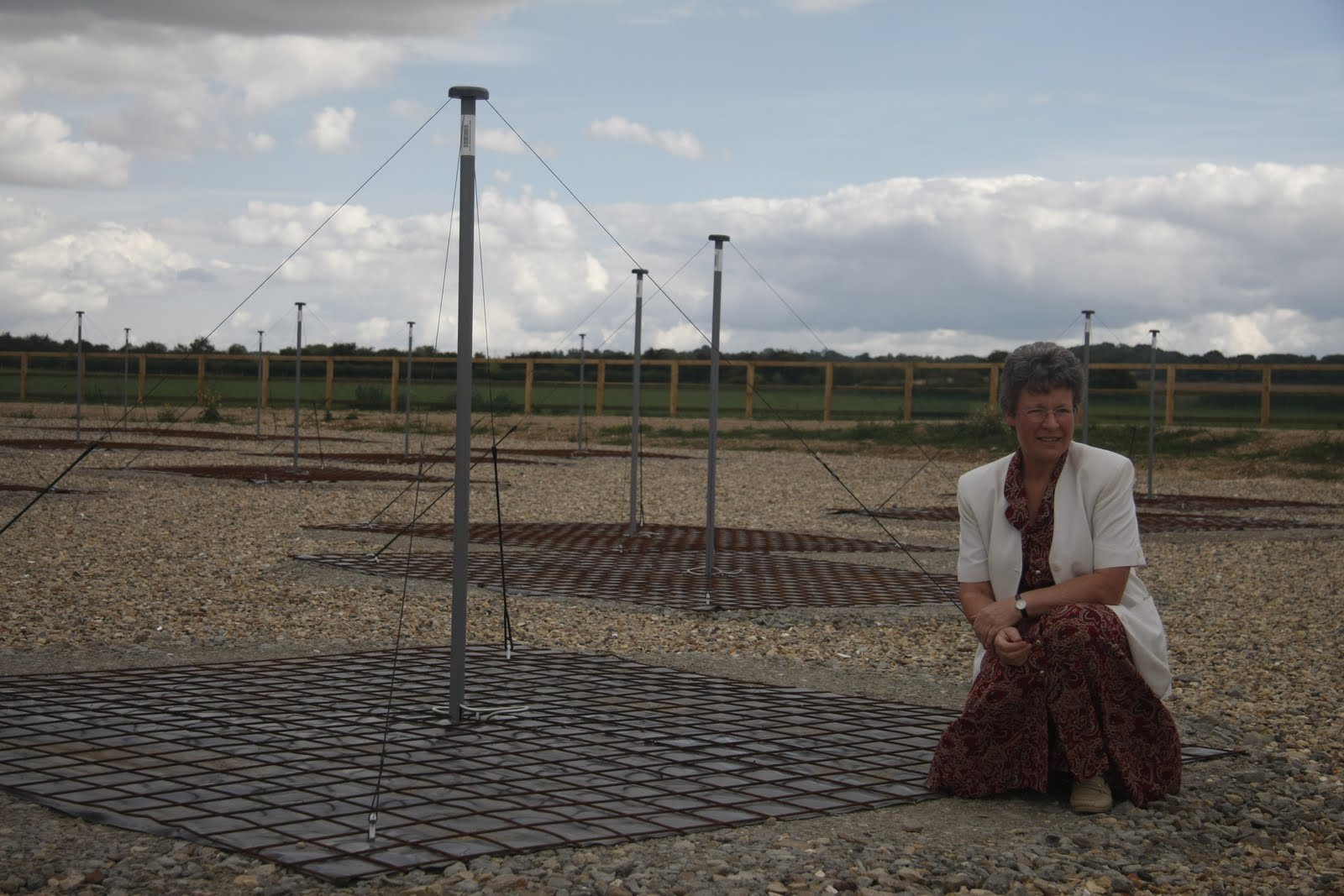
Jocelyn Bell Burnell wins award for lifetime contributions to radio astronomy

Jocelyn Bell Burnell at the LOFAR-UK station in Chilbolton in September 2010. Credit: James West, SEPnet.
Prof. Jocelyn Bell-Burnell, who opened the LOFAR-UK station back in September has been awarded the 2011 Grote Reber Gold Medal for lifetime innovative contributions to radio astronomy from the US National Radio Astronomy Observatory. The full story from NRAO is reproduced below and can be read on their website here


2011 Grote Reber Gold Medal
Ken Kellerman


The 2011 Grote Reber Gold Medal for lifetime innovative contributions to radio astronomy will be awarded to Dr. Jocelyn Bell Burnell who is currently a Professor of Astrophysics at Oxford University in England.  Burnell is being honored for her dramatic 1967 discovery of pulsars, which has had a major impact on 20th century astrophysics, and her continuing contributions to astrophysics and education.
Jocelyn Bell Burnell received her first degree in Physics in 1965 from Glascow University in Scotland and her PhD from the University of Cambridge in 1968.  Following a two year Science Research Council Fellowship, she held a Teaching Fellowship at the University of Southampton followed by research and management positions at the University College, London and the Royal Observatory in Edinburgh. After a ten year period as a Professor of Physics at the Open University of the United Kingdom where she studied X-ray sources, she served as Dean of Science at the University of Bath.

Bell-Burnell is best known for her role in the discovery of pulsars. As a research student in Cambridge she was heavily involved in the construction and operation of a long wavelength radio telescope built to study interplanetary scintillations at 4 m wavelength.  Later, while inspecting the output chart records, she noticed a peculiar signal form that had a periodic pulse rate close to one second. Like Grote Reber, she initially had to convince her better-established colleagues that her observations were important for astronomy and not due to external interference or a spurious instrumental effect.

She has previously been honored by many prizes and recognitions, including the Albert Michelson Medal of the Philadelphia Franklin Institute, the J. Robert Oppenheimer Memorial Prize from the Miami Center for Theoretical Studies, the Tinsley Prize from the American Astronomical Society, and the Herschel Medal from the Royal Astronomical Society.  She has served as President of the Royal Astronomical Society, is a Fellow of the Royal Society, is currently the President of the Institute of Physics, and in June 2007, she was made Dame Commander of the British Empire (DBE) by Queen Elizabeth II.  

The 2011 Reber Medal will be presented to Dame Jocelyn in August 2011 at the XXX URSI General Assembly in Istanbul, Turkey.

The Reber Medal was established by the Trustees of the Grote Reber Foundation to honor the achievements of Grote Reber and is administered by the Queen Victoria Museum in Launceston, Tasmania.  Nominations for the 2012 Medal may be sent to Martin George, Queen Victoria Museum, Wellington St, Launceston, Tasmania 7250, Australia or by e-mail to: martin@qvmag.tas.gov.au to be received no later than 15 October 2011.http://science.nrao.edu/enews/4.3/index.shtml#groterebermedal

Tuesday, February 8, 2011

LOFAR - the Largest Telescope in the World....?

The International LOFAR Telescope (ILT) claims to be the largest telescope in the world..... why?

Obviously radio telescope are much larger than telescopes in any other wavelength. The largest optical telescopes at the moment have mirrors up to about 10 metres across - an extremely impressive feat considering the small wavelength of the light they observe (which means the mirrors have to be extremely smooth).  But radio waves are much larger (metres in size instead of nanometres) so radio telescopes have to be proportionally larger.

Mist filling the Arecibo Radio Telescope Dish. Credit: Karen L. Masters (June 2000). 

 Single dish radio telescopes are in operation which are up to 30 times larger than the largest optical telescope (the giant Arecibo radio telescope  shown above is 305 metres across). Dwarfing even those though are the interferometers. These are networks of radio telescopes or antennas which use computers to combine the signals they collect and make virtual telescopes with massive sizes. As computers have got more and more powerful, it is this kind of radio telescope which makes the most sense to build, and at the moment the ILT is the largest of of them all.

The LOFAR Superterp (part of the core) in the Netherlands. Credit: ASTRON

Once you move to "virtual telescopes" like this though, there are several different ways to describe the size of the telescope. The most obvious is the width of the array (the largest distance between two antennas in it). This sets the resolution of the images your array will take (the sharpness, or zoom level if you like). Then there's the surface area - basically how much of the area inside your array is covered by radio antennas or dish. This helps to set the sensitivity of the telescope - the more of the radio signal you can collect the fainter the objects you'll be able to see. And finally there's how many different antennas you have. Some arrays are made of a small number of fairly large radio telescopes, others (like LOFAR) have a larger number of smaller antennas arranged in stations.

So how does LOFAR compare with some of the other radio interferometers out there. Well I have collected some numbers in the below table. As you can see LOFAR (or the ILT to use the proper name) is one of the largest in terms of maximum dimension - however both the US and European VLBI (Very Long Baseline Array) facilities have larger sizes by that metric. But LOFAR easilly beats everything at the moment in terms of the number of antennas, number of stations, and (effective) collecting area. So it can really claim to be the largest telescope in the world.

Of course larger facilities are being planned. LOFAR in many ways is a pathfinder for the SKA (Square kilometre array - the name of which refers to the goal of having 1km^2 collecting area (1 million m^2). The details of exactly how this will be achieved are still being worked out, but it's likely to involve very large numbers of antennas. Also in the construction/design phase are many other similar facilities like ASKAP (The Australian SKA pathfinder), MWA (The Murchison Wide Field Array) and LWA (the Long Wavelength Array) all consisting of large numbers of dipoles arranged in stations (edit: thanks to John Swinback for pointing out ASKAP is actually an array of 36 12m dishes - not dipoles).

So LOFAR's claim to be the largest telescope in the world likely won't be true for long. We live in exciting times for radio astronomy.


Table comparing properties of LOFAR (ILT) with other currently running large radio telescope arrays (note that that other facilities listed below also work at shorter radio wavelengths than LOFAR).
NameLocationNumber antennasNumber stations(Effective) collecting areaMax dimension
LOFAREurope2976 LBA and 1680 HBA tiles (a)31 (b)Upper limits range between 396800 m^2 (LBAs at 15 MHz), 14000 m^2 (HBAs at 240 MHz) for 31 stations (c) 920 km (d)
EVLAUSA27 dishes2727*25m dishes = 13250 m^236 km
European VLBI NetworkEurope16 dishes16 (e)11000 km
VLBAUSA10 dishes1010*25m dishes = 4900 m^28600 km
eMERLINUK7 dishes76*25m dishes, plus Lovell. (76.2m) = 7500 m^2217 km

(a) Dutch stations have 96 LBA and 48 HBA tiles each, International stations have 96 LBAs and 96 HBA tiles each. Currently 4 international stations (384 LBA and 384 HBA times), and 27 Dutch (2592 LBAs and  1296 HBA tiles), although each HBA tile actually has 16 antennas in it - so could count this as 20736 Dutch HBA antennas and 6144 international HBA antennas.

(b) 31 stations "completed" as of Feb 2011, 9 more under construction. Current status: http://www.astron.nl/~heald/lofarStatusMap.html

(c) This is wavelength dependent for dipoles. Numbers based on Discussion of LOFAR effective area on ASTRON website.

(d) Largest dimension at present is Tautenburg-Chilbolton which is 920 km.

(e) Still to work out. Need to find specs for each dish.

Monday, February 7, 2011

The Long Wavelength Array

I just learned that a sister project to the LOFAR LBAs (low band antennas) is underway in the US. This project is called the Long Wavelength Array (LWA) and like our LBAs uses large numbers of spindly looking antennas to survey the sky at 20-80MHz (radio frequencies below the FM band down to the limit of what will pass through our ionosphere). As part of the LWA project, a nice write up of the motivations for low frequency radio astronomy appeared online last week: "An Astronomers Field of Dreams".

They're in the middle of putting together their first station, and hope to begin observations this summer. For more details see the LWA website.


Multiple antennas of the LWA-1 station of the Long Wavelength Array in central New Mexico, photographed at sunset. Each antenna stands about 1.5 meters (5 feet) high and about 2.7 meters (9 feet) across the base. Image credit: LWA Project (at UNM).

Thursday, December 9, 2010

First Image from eMERLIN

Today is an exciting day for UK radio astronomy as eMERLIN has released its first image. This dramatic image shows the Double Quasar. In the image, light from a quasar billions of light years away is bent around a foreground galaxy by the curvature of space. A quasar is a galaxy powered by a super-massive black hole, leading to the ejection of jets of matter moving at almost the speed of light - one of which can be seen arcing to the left in the image.

This is a composite of the new e-MERLIN radio image of the Double Quasar and an earlier Hubble Space Telescope (HST) optical image. The radio emission generated by the black hole as seen with e-MERLIN is visible as the compact bright region superimposed on the (yellow-green) optical emission seen by HST.  
The e-MERLIN image is shown in false-colour with a colour table ranging from blue through red to white, where the colours represent the brightness of the radio emission. The HST image is made from WFPC2 images through two filters: the F555W filter (V-band) is coloured green and the F814W filter (I-band) is coloured red.
Credit: Jodrell Bank Centre for Astrophysics, University of Manchester 

e-MERLIN is an array of seven radio telescopes, spanning 217km, connected by a new optical fibre network to Jodrell Bank Observatory.


 As a radio telescope array eMERLIN of course has many similarities to LOFAR, but to readers familiar with LOFAR there are also several big differences. To start with eMERLIN observes at much higher frequences (shorter wavelengths) than LOFAR. The frequency (or equivalently wavelength) of electromagnetic radiation which can be detected using radio technology stretches all the way from sub-mm radiation (at many GHz) down to the limit set by the ionosphere at 30MHz (many metres in wavelength). eMERLIN detects radiation in three radio bands at roughly 1.5, 5 and 22 GHz, while LOFAR has two bands at much lower frequency (LBA at 30 - 80 MHz and the HBA at 120 - 240 MHz). This change in frequency means that the tecnhology for the antennas is much different. LOFAR as you know uses many dipole antennas all connected together by software for each "station". This would not work for the frequencies observed by eMERLIN which requires each point in the array to be a "traditional" radio antenna (as illustrated above). 

This e-MERLIN image demonstrates the successful transmission of wide-bandwidth digitised signals from all the telescopes remote from Jodrell Bank over the optical fibre network. This initial image, taken at a frequency of roughly 6.5 GHz, has an angular resolution of 50 milli-arcseconds, similar to the resolution of the Hubble Space Telescope. The new system is already approaching 3 times the sensitivity of the previous radio-linked MERLIN telescope. This will result in a very substantial (around a factor 5) further increase in sensitivity. Operations at full sensitivity, (achieved by including the Lovell telescope and upgrades of the bandwidths in the data links) are expected in 2011.

For more details see the press release at Jodrell Bank.