Showing posts with label reports. Show all posts

Monday, May 16, 2011

Chilbolton & Wherwell Local Information Day

On Saturday 14 May 2011 a visitors' day was held at the LOFAR Chilbolton site. This was a requirement of our LOFAR planning application, namely that we host some form of public-information event for the local communities of Wherwell and Chilbolton Village. Three members of the LOFAR-UK team (Derek McKay-Bukowski, Brian Ellison and Malcolm Coe) were at hand to show visitors around the Low-Band and High-Band Arrays and to give them a rare glimpse inside the RF-container.

In all, it was a very successful day, with lots of interesting questions. In total we had over 75 guests at the site. We certainly hoped that all our visitors enjoyed the event. Hopefully, we will be able to hold an open day for the general public sometime in the future as well. And many thanks to Brian and Malcolm for giving up part of their weekend to assist Derek with explaining the LOFAR-UK facility.


Brian Ellison (in the high-vis vest) explains how the LBA aerials work to locals including Graham and Brian Patterson (on his left and right respectively).

Wednesday, April 13, 2011

Aerial photographs of LOFAR-UK Chilbolton

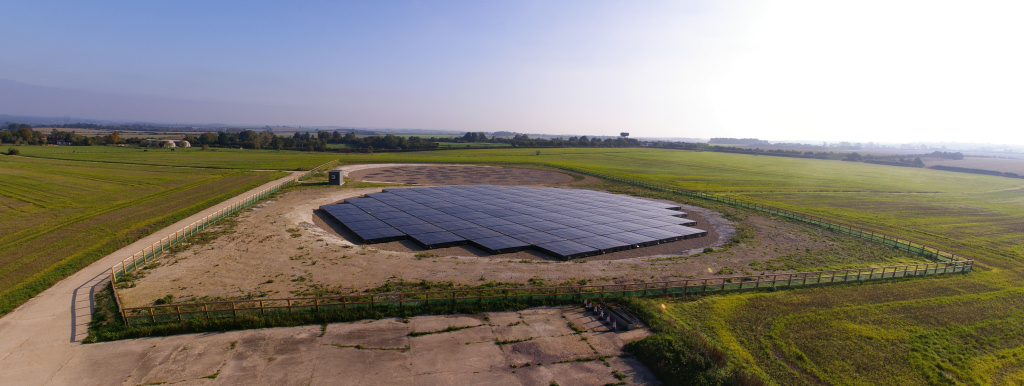
Some dramatic photographs have just been posted on the Press and Media Image Library of the UK's Science and Technology Facilities Council (STFC). These show the LOFAR station at Chilbolton, Hampshire, UK, as seen from the air. Although there are plenty of photographs of various LOFAR stations from the ground, and plenty of diagrams showing the layout of the sites, this is a good opportunity to get a bird's-eye view of what a station looks like.

The credit for all these images goes to Guy Gratton, who took the photographs during the afternoon of Friday 8th April 2011, and who graciously gave permission for their use by the STFC/LOFAR community. The images were taken from an aeroplane flying at an altitude of approximately 300 metres (1000 ft) over the site, through an open door on the aircraft to avoid any window reflections.

Banking away from the LOFAR field, you can see the Chilbolton 25m dish
(Photo: 
Guy Gratton (c) 2011, hosted by STFC.)

Looking specifically at the LOFAR-UK station (LOFAR-ID = UK608). The HBA is on the left and the LBA is on the right. If you look carefully, you can just make out the RF-container in the space between where the two fields meet and the access road. (Photo: Guy Gratton (c) 2011, hosted by STFC.)


When you start to move further back, more the surrounding facilities become apparent. Apart from the main 25m dish, there is a small 4.5m dish on the right-hand side, just below the LOFAR compound. (Don't forget you can click on images for a slightly enlarged view.)

Looking at the site from even further away, the scale of the Chilbolton Observatory becomes clear. (Photo: Guy Gratton (c) 2011, hosted by STFC.)


The LOFAR-UK site, as seen from the air. 
(Photo: Guy Gratton (c) 2011, hosted by STFC.)
The above photograph is a great way to appreciate the scale of an international LOFAR station. The dish near the top of the photograph is the 25m parabola of the Chilbolton Observatory.

Check the STFC's Press and Media Image Library for all high-quality photographs of the LOFAR-UK station. You can also find full-resolution versions of some of the above photographs, suitable for use in printed media. Thanks goes to the Chilbolton Observatory and UK608 project teams, the RAL-Space outreach team and, of course, Guy Gratton for the great photographs.

Monday, November 15, 2010

Turbo-fans


Here's a rare peek inside one of the signal processing servers. Note the two forced-air heat-sinks on the motherboard. This computer is one of four servers that will be used to control the array of GPU-processors which, in turn, will perform the de-dispersion calculations (see Heavy Duty Computing).

And, yes... when they are running all of these machines make a LOT of noise!

Friday, November 12, 2010

Cable Calibration

In order to form the best possible result out of the LOFAR system, it is essential that we can calibrate for the signal travel-times. This means not only being able to know the direction from whence the signal came, but also how long it takes to travel through every cable and every circuit.


Each cable within the system is carefully manufactured and labelled. The serial number on the cable contains information about its performance and role. For example, the one in the photograph (CHY-0853425-1305090755) is an "C"able from the "H"igh-Band Array, "Y"-polarisation. It is "085" metres long and has a delay of "3425" tenths of a nanosecond. This means that, in laboratory conditions, it takes 342.5 nanoseconds for a signal to travel down this cable.

However, that is in the lab.

Although this is a pretty good measurement, to really get the best performance we need to know the signal delay in the field, now that the cable is in place. Things such as connectors, thermal variations and other deployment factors can contribute to subtle variations in the effective cable length. Calibrating these sorts of things is part of the vital commissioning work that is currently being carried out on the LOFAR Chilbolton station.

Wednesday, November 10, 2010

Shut the door!


Inside the RF-container lies all the electronics that does the signal processing. Because there is so much of it, and it is so close to the antenna array, it is crucial that it is shielded to prevent interfering signals from escaping from these electronics to feedback into the system.

Now that we've started taking routine calibration and test data, it is important to keep the RF-contain sealed against unwanted radio leaks.


The notice on the door reads: "INTERFERENCE HAZARD - The equipment in this RF-container can disrupt telescope observations. Do not open this door without first checking with the Operations Group."

Monday, November 8, 2010

Heavy Duty Computing

With the main antenna arrays now complete, we are now concentrating on getting the data processing equipment set up. One of the major components of this is the computer system that will perform the de-dispersion calculations. Dispersion is a physical phenomenon where the signals at different frequencies travel at different speeds through a medium. In our case, lower-frequency radio waves travel through the interstellar medium slower than higher-frequency radio waves.

In order to add signals together (for example to analyse the pulses from a pulsar), one must first apply a correction for the dispersion that occurs. Although it is possible to estimate what the dispersion will be, based on our knowledge of the Galaxy, ultimately one has to simply try lots of different dispersion measures.

That means a lot of calculations, which means we need some pretty high powered, specialist computing to do the work. The project to do this for LOFAR is being led by the University of Oxford on behalf of SEPnet.

Caption 1 :  Dispatch from the University of Oxford.

Caption 2 : Aris Karastergiou unloads another GPU-server from the delivery van.


Friday, November 5, 2010

LOFAR HAKU


The RF-Container at the Chilbolton LOFAR station is an adapted shipping container. Because ships and storage facilities can hold many tens of thousands of containers, it is important to be able to identify them. As a result, containers from a given manufacturer are marked with a unique 7-digit serial number (strictly speaking it is a 6-digit code plus a single-digit checksum). Additionally, the serial number is prefixed by a four-letter code to denote the company that built the container (these prefixes always end in the letter "U"). The code for the RF-container at Chilbolton is HAKU2961555.

HAKU is the prefix for containers manufactured by "Container Company Amsterdam BV".

However, HAKU has another meaning.

During the visit from the ionospheric physics group, Derek McKay-Bukowski described the LOFAR system, with its multiple beams, rapid direction-switching and de-dispersion back-end, as an "astronomical search engine". After the presentation, an e-mail was received from Thomas Ulich, asking if we knew what the "HAKU" on the side of the container meant. While we were aware of the container serial number, as explained above, what wasn't known was that "haku" is the Finnish word for "search". Thomas explained that "hakukone" means "search engine" in Finnish; "kone" is engine, and "haku" means "search, fetch, retrieval", but also "quest, trawl".

So our LOFAR container certainly has the correct name!

Thursday, November 4, 2010

Ionospheric Visit

Because of the frequencies at which LOFAR observes, an understanding of the ionosphere is crucial to the interpretation of our results. On the other hand, LOFAR also offers a powerful tool for investigating this tenuous layer of the earth's atmosphere.

On 27-28 September 2010, a special meeting was organised by the UK solar-terrestrial physics community (MIST) to celebrate the life and work of the late Prof. Henry Rishbeth (1931-2010). The meeting took place in his home city of Southampton, and celebrated Henry's long commitment to the advancement of ionospheric science. And, on the afternoon of the 28th, a number of the attending physicists visited the LOFAR Chilbolton station. (Photograph by Th. Ulich.)


This post also appears on the STFC RAL website.

Thursday, October 14, 2010

Fibre

Yesterday and Tuesday, the BT engineers were on site to install the network termination equipment (NTE) for the 10 gigabit link. This is the connection equipment that will transmit the data from the main Chilbolton building to the next major network point which is located in Southampton.

Caption 1 : The BT van arrives at the main building at Chilbolton Observatory

Caption 2 : Installed. This is what the connection looks like in the comms room at the observatory.

Wednesday, October 13, 2010

Overview Images

Yesterday at Chilbolton, we made use of the trailer-mounted cherry picker. The first image was made from a height of approx. 10 metres above the hard compound at the end of the HBA array. It gives a great view of the HBA, but the LBA is still visible in the distance.

The second image is from the opposite right side, looking back over the LBA, but also with an excellent view of the HBA and 25m dish in the background. It was made from a height of approx. 16 metres.

The final image shows the photographer in action; not a job for anyone with a fear of heights.

Tuesday, September 21, 2010

Sign of the times

The finishing touch on the LOFAR field was putting up the sign. On it, apart from the station name (LOFAR-UK Chilbolton) and number (UK608), there are the logos/names of all the contributing organisations.

Official hand over from ASTRON

On the morning of 20th September 2010, just ahead of the official opening, the delegation from ASTRON arrived at Chilbolton Observatory to review the progress and hand over the LOFAR station formally to STFC and LOFAR-UK. Part of this included an inspection of the site and the comments were all extremely positive concerning the professional work done, efficiency of the build and the final presentation and attention to detail. During the handover meeting itself, Corina Vogt (the ASTRON representative) said that the only thing she had to say about the field was "Wow!"

Caption : Corina Vogt, Michiel van Haarlem and Harm Munk at LOFAR Station UK608.

Sunday, September 19, 2010

Ready for a new era of British Astronomy

The LOFAR Chilbolton Radio Telescope now stands ready for the official opening, which is due to be held on Monday 20th September 2010. Although the opening is but a single moment in a long programme of construction, installation and commissioning, it is a significant one. And now is a good time to pause and reflect on the past few months and what work has been achieved. To have come so far so quickly has been fantastic and everyone involved in this project should be proud of all that we have accomplished and look forward to the significance and celebration that will follow.


Caption : Looking through the LBA field at sunset. The monolith on the horizon is the RF container and in the distance the silhouette of the 25m dish can be seen.

Replacement Signal Processing Board

During the commissioning work, we discovered that one of the network connections on one of the digital signal processing boards was not working correctly. By exchange modules with others, we could determine that the fault was located in this particular board. As soon as we have completed the detective work, ASTRON were notified and a replacement board was sent out immediately.


Caption: This new board has now arrived and was fitted and initialised. The photograph shows the board as it was being unpacked. The new component is now fully fitted and is working correctly.

Saturday, September 18, 2010

Aerial at dusk

This photograph is a close-up shot of one of the low-noise amplifier (LNA) modules that is found at the head of each low-band array (LBA) aerial. This particular one is number #76, the number of which can be discerned in amongst the other code sequences on the bar-coded label.

More commissioning work

With only a few days until the official opening, everyone is really putting in the hours to ensure that as much commissioning work is being accomplished as possible.


Caption: Aris Karastergiou works late into the evening with the configuration of the Local Control Unit in the RF-container.

Front desk

At the front desk at Chilbolton Observatory is Jan Lass. Now, Jan is just great; she is the friendly smile whenever our visitors or colleagues arrive at the site and she ensures that everything remains organised and efficient. Jan has been instrumental in sorting out some of the important contracts that were placed for the LOFAR project and we have only managed to get this far because of her work behind the scenes.

Caption: Many thanks Jan, we really appreciate all you have done for the LOFAR Chilbolton project!

Friday, September 17, 2010

Installing the data processing system

The data processing system for the LOFAR Chilbolton station is being developed by Oxford University. When complete, it will be a large system with multiple server and control computers as well as a small cluster of GPU blades to do the heavy-duty number crunching. As part of the initial commissioning work, a small part of the final system is set up temporarily in the comms room at the Chilbolton Observatory, in order to test the system.


Caption : Aris Karastergiou (left) and Alan Doo at work on the installation of the two GPU blades in the rack on the left. The tangled bundles of cables on the right are NOT part of the LOFAR system!

Checking the polarisation

There are a lot of connections within the system and it is important to check that they are all working. One that is difficult to notice is the polarisation of the signal. In order to test this, a temporary test transmitter is setup, which sends out a low-power signal. This is then used to check that the correct signal is going through the correct chain in the electronics.


Caption : Here is the test aerial. The RF-container can be seen in the background.

Thursday, September 16, 2010

Skip nothing

On 2nd September 2010, the skip that was located at the LOFAR field site was removed and brought back to the main Observatory compound. From there, it was loaded with a few more items which needed disposing of from there. However there was very little waste to be removed.


Caption : Here the skip is about to be loaded onto the lorry for the last time before leaving the site.