Showing posts with label Jocelyn Bell Burnell. Show all posts

Wednesday, January 4, 2012

LOFAR-UK Station Damaged by Storms

During the night of 2nd-3rd Jan 2012, gale force winds over the UK resulted in some damage to the LOFAR international station UK608, located at the Chilbolton Observatory near Winchester in Hampshire. Wind speeds at the site exceed 60 mph (97 km/h) accompanied by heavy rain, as a major low pressure system began to pass over the UK. 

Image of the UK storm early in the morning of Jan 3rd 2012 from NASA's Aqua Satellite (via @metofficestorms)

Chilbolton staff working in the main building (about 1 mile from the array) noticed a dislodged HBA (high band antenna) cover on the morning of Jan 3rd 2012. A HBA tile is made up of 16 antennas held in place by white polystyrene cells all covered by a thick black weather proof cover, making a dislodged cover dramatically visible from a distance. 

An image of an HBA with part of the cover removed for testing. This reveals some of the lids, plus one antenna "cell" with the lid removed. You can also see more of the structure of HBAs in our video tour of Chilbolton.
Fortunately only one of the HBA tiles lost its cover, but 10 of the antenna "cells" within this tile lost their lids exposing the delicate antenna parts to heavy rain and damaging some of the internal structure. Debris was also blown all over the fields around UK608.

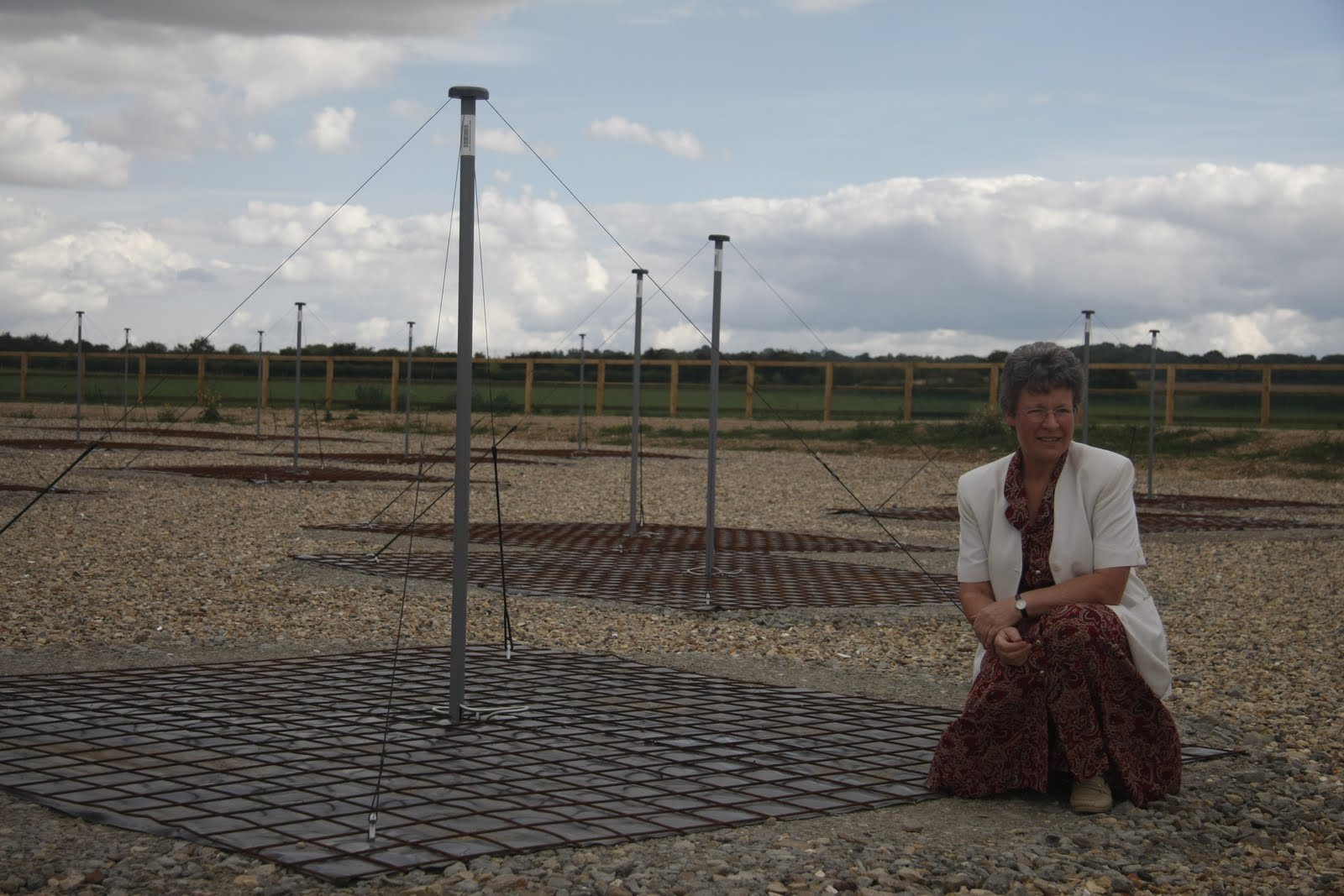
Unfortunately the LBA (low band antenna) array fared much worse. In total thirteen of the 96 antennas have been damaged or destroyed. Two of these antennas were completely blown away (including the metal grids), and eleven have been blow down. A further four antennas have been dislodged and may be partially damaged. 

Dame Jocelyn Bell-Burnell poses by an LBA during the UK608 opening. For more information on LBAs see our Chilbolton video tour.

Chilbolton staff members should be thanked by all of us for extraordinary effort during the ongoing severe weather yesterday (gale force winds and torrential rain) to mitigate further damage and collect debris.  They have been hard at work again today further securing the damaged array, as the UK is not out of the weather yet with moderate to strong winds forecast for the next 24 hours.

Work is also ongoing to assess the full extent of the damage, particularly to the LBA array, and make plans for the repairs. However the design of a LOFAR station is such that it can function at almost full efficiency with a few antennas down. So while the loss of a full HBA looks dramatic, it should only have a minor effect on the data quality in the high band. And the remaining (up to) 83 functioning LBAs (or 86% of the antennas) should also be able to make successful observations. 

Thursday, March 10, 2011

Jocelyn Bell Burnell wins award for lifetime contributions to radio astronomy

Jocelyn Bell Burnell at the LOFAR-UK station in Chilbolton in September 2010. Credit: James West, SEPnet.
Prof. Jocelyn Bell-Burnell, who opened the LOFAR-UK station back in September has been awarded the 2011 Grote Reber Gold Medal for lifetime innovative contributions to radio astronomy from the US National Radio Astronomy Observatory. The full story from NRAO is reproduced below and can be read on their website here


2011 Grote Reber Gold Medal
Ken Kellerman


The 2011 Grote Reber Gold Medal for lifetime innovative contributions to radio astronomy will be awarded to Dr. Jocelyn Bell Burnell who is currently a Professor of Astrophysics at Oxford University in England.  Burnell is being honored for her dramatic 1967 discovery of pulsars, which has had a major impact on 20th century astrophysics, and her continuing contributions to astrophysics and education.
Jocelyn Bell Burnell received her first degree in Physics in 1965 from Glascow University in Scotland and her PhD from the University of Cambridge in 1968.  Following a two year Science Research Council Fellowship, she held a Teaching Fellowship at the University of Southampton followed by research and management positions at the University College, London and the Royal Observatory in Edinburgh. After a ten year period as a Professor of Physics at the Open University of the United Kingdom where she studied X-ray sources, she served as Dean of Science at the University of Bath.

Bell-Burnell is best known for her role in the discovery of pulsars. As a research student in Cambridge she was heavily involved in the construction and operation of a long wavelength radio telescope built to study interplanetary scintillations at 4 m wavelength.  Later, while inspecting the output chart records, she noticed a peculiar signal form that had a periodic pulse rate close to one second. Like Grote Reber, she initially had to convince her better-established colleagues that her observations were important for astronomy and not due to external interference or a spurious instrumental effect.

She has previously been honored by many prizes and recognitions, including the Albert Michelson Medal of the Philadelphia Franklin Institute, the J. Robert Oppenheimer Memorial Prize from the Miami Center for Theoretical Studies, the Tinsley Prize from the American Astronomical Society, and the Herschel Medal from the Royal Astronomical Society.  She has served as President of the Royal Astronomical Society, is a Fellow of the Royal Society, is currently the President of the Institute of Physics, and in June 2007, she was made Dame Commander of the British Empire (DBE) by Queen Elizabeth II.  

The 2011 Reber Medal will be presented to Dame Jocelyn in August 2011 at the XXX URSI General Assembly in Istanbul, Turkey.

The Reber Medal was established by the Trustees of the Grote Reber Foundation to honor the achievements of Grote Reber and is administered by the Queen Victoria Museum in Launceston, Tasmania.  Nominations for the 2012 Medal may be sent to Martin George, Queen Victoria Museum, Wellington St, Launceston, Tasmania 7250, Australia or by e-mail to: martin@qvmag.tas.gov.au to be received no later than 15 October 2011.http://science.nrao.edu/enews/4.3/index.shtml#groterebermedal

Wednesday, September 22, 2010

Video of Ribbon Cutting at Chilbolton

This video shows hi-lights from the part of the LOFAR-UK opening on Monday 20th September 2010 which took place at the Chilbolton Observatory itself. This included a ribbon cutting by Dame Jocelyn Bell-Burnell, and some real time observations of a bright pulsar (as explained by Dr. Aris Karastergiou).

Coverage of the Opening

There has been some online coverage of the opening events on Monday. Here's a collection of links. If you have something to add let me know.

BBC Science Article

Redorbit (Science, Space, Technology and Health News and Information)

Space Daily

Sify News (Indian News)

LOFAR-UK links:

Universities:

Birmingham,
Edinburgh,
Portsmouth,
Southampton,
Sussex

STFC Press Release (which includes a video of the ribbon cutting and the first pulsar observations)

Tuesday, September 21, 2010

Official LOFAR-UK Opening

Yesterday was a big day for LOFAR-UK. The station at Chilbolton was officially handed over (as per an earlier blog report) and was also officially opened by Dame Jocelyn Bell Burnell in a ribbon cutting ceremony out in the field.


(Picture taken by James West, SEPnet)

This ribbon cutting was followed by real time observations of one of the brightest pulsars in the sky (thanks to Aris Karastergiou from Oxford Univ. who had worked very hard and set up some impressive computing to process the data to show us in real time). Jocelyn seemed very pleased to see the telescope worked, and was very excited particularly about it's potential to detect new transient radio emitters.


(Picture taken by James West, SEPnet)

After the Chilbolton event was a celebratory event held at the nearby Intech Science Centre. Rob Fender (LOFAR-UK PI, Southampton Uni), John Womersley (STFC), Mike Garrett (ASTRON) and Derek McKay-Bukoswki (Chilbolton Station Project Manager) all gave talks, and then Jenny Shipway (Intech Planetarium Manager) gave us a wonderful planetarium show specially adapted to include links to LOFAR science. I think I can speak for most astronomers in the room by saying that we don't get to see planetarium shows very often, and it was a wonderful reminder of the inspirational science behind why most of us got into this game in the first place.

Also we had cake.

(Picture taken by Bob Nichol, Portsmouth).

Well done to everyone involved.