The LOFAR overview paper is now in press at Astronomy and Astrophysics. You can read all about it in this ASTRON press release, and download the paper itself from the arxiv:1305:3550.
Showing posts with label paper. Show all posts
Showing posts with label paper. Show all posts
Tuesday, May 28, 2013

Friday, October 5, 2012
A LOFAR View of M87
A paper appears on the arxiv today with new images of the centre of nearby elliptical galaxy M87, taken with the Dutch LOFAR stations.
M87 at Metre Wavelenghts: the LOFAR Picture, by de Gasperin et al. (A&A in press).
M87 (also known at Virgo-A) is one of the two massive elliptical galaxies found at the centre of our nearest cluster of galaxies (the Virgo cluster).
In the centre of M87 is a well know actively accreting supermassive black hole, which is emitting jets of energetic particles which emit significant amounts of radio. These jets are even (just) visible in optical images of M87 (the blue line below).
M87 has often been a poster child for radio astronomy images. These images of the jet taken by the NRAO's VLA can be seen in many talks about radio galaxies and AGN.
And especially this series of images zooming into the central regions.
The paper on the arxiv today used observations of M87 with both the HBA and LBA arrays of LOFAR. The Dutch stations only were used in this observation - adding in international stations like Chilbolton will be able to increase the resolution even further, and I will look forward to seeing that in the future.
M87 at Metre Wavelenghts: the LOFAR Picture, by de Gasperin et al. (A&A in press).
M87 (also known at Virgo-A) is one of the two massive elliptical galaxies found at the centre of our nearest cluster of galaxies (the Virgo cluster).
In the centre of M87 is a well know actively accreting supermassive black hole, which is emitting jets of energetic particles which emit significant amounts of radio. These jets are even (just) visible in optical images of M87 (the blue line below).
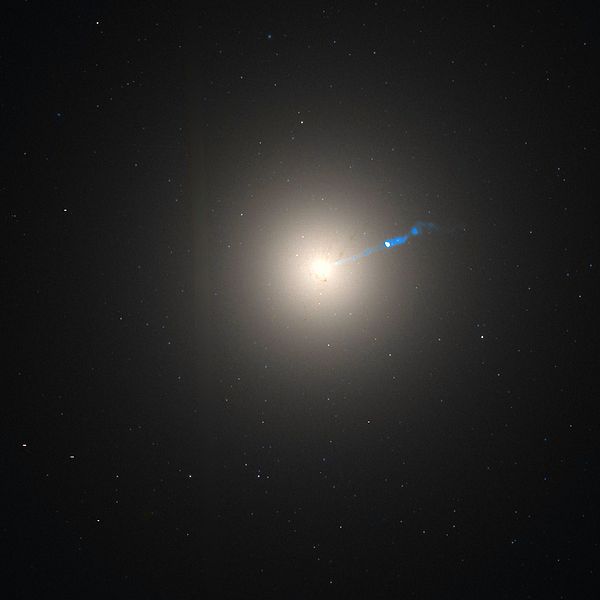 |
| Optical image of M87 taken with Hubble Space Telescope. Scale 3x3 arcmins. More details. |
M87 has often been a poster child for radio astronomy images. These images of the jet taken by the NRAO's VLA can be seen in many talks about radio galaxies and AGN.
 |
| M87 imaged at 90cm (300 Mhz) with the VLA. Scale 15x15 arcmin. More details. |
 |
| For more details see the APOD entry for this image. |
The paper on the arxiv today used observations of M87 with both the HBA and LBA arrays of LOFAR. The Dutch stations only were used in this observation - adding in international stations like Chilbolton will be able to increase the resolution even further, and I will look forward to seeing that in the future.
I have extracted two of the images from the paper. This first was taken with the HBA at 140 MHz (2.1 m) and shows an area 15x15 arcmin in size (same as the VLA image above, but at wavelengths more than twice as large).


These new observations at lower frequencies than ever before allow scientists to better constrain the spectral shape of the radio emission from the jets, which in turn can be used to constrain the details of how the supermassive black hole in the centre of M87 is able to power these extremely extended emission regions.

And this shows one of the many LBA images made - this one at 25 Mhz (12m) of a slightly larger sky area (21x21 arcmin).

Wednesday, May 23, 2012
Colliding galaxy cluster unravelled
The below is a press release put out today in support of the paper: First LOFAR observations at very low frequencies of cluster-scale non-thermal emission: the case of Abell 2256, van Weeren et al. A&A in press (arXiV:1205.4703)
 |
| Galaxy cluster Abell 2256 imaged at 60 MHz with LOFAR |
An international team of astronomers has used the International LOFAR Telescope from ASTRON, the Netherlands Institute for Radio Astronomy, to study the formation of the galaxy cluster Abell 2256. Abell 2256 is a cluster containing hundreds of galaxies at a distance of 800 million lightyears. ‘The structure we see in the radio images made with LOFAR provides us with information about the origin of this cluster, explains lead author dr. Reinout van Weeren (Leiden University and ASTRON). The study will be published in the scientific journal Astronomy & Astrophysics. The research involved a large team of scientists from 26 different universities and research institutes.
LOFAR has made the first images of Abell 2256 in the frequency range of 20 to 60 MHz. What came as a surprise to scientists was that the cluster of galaxies was brighter and more complex than expected. Dr. van Weeren: ‘We think that galaxy clusters form by mergers and collisions of smaller clusters’. Abell 2256 is a prime example of a cluster that is currently undergoing a collision. The radio emission is produced by tiny elementary particles that move nearly at the speed of light. With LOFAR it is possible to study how these particles get accelerated to such speeds. ‘In particular, we will learn how this acceleration takes place in regions measuring more than 10 million light years across’, says Dr. Gianfranco Brunetti from IRA-INAF in Bologna, Italy, who together with Prof. Marcus Brüggen from the Jacobs University in Bremen, coordinates the LOFAR work on galaxy clusters.
LOFAR was built by a large international consortium led by the Netherlands and which includes Germany, France, the United Kingdom and Sweden. One of the main goals of LOFAR is to survey the entire northern sky at low radio frequencies, with a sensitivity and resolution about 100 times better than what has been previously done. Scientists believe that this survey will discover more than 100 million objects in the distant Universe. ‘Soon we will start our systematic surveys of the sky that will lead to great discoveries’, says Prof. Huub Röttgering from Leiden University and Principal Investigator of the 'LOFAR Survey Key Project'.
For more information, please contact:
Dr. Reinout van Weeren, astronomer, Leiden University and ASTRON. Tel.: +31 71 527 5864. E-mail: rvweeren@strw.leidenuniv.nl
Prof. Huub Röttgering, astronomer, Leiden University. Tel.: +31 6 41522603. E-mail: rottgering@strw.leidenuniv.nl
Femke Boekhorst, PR & Communication, ASTRON. Tel.: +31 521 595 204. E-mail: boekhorst@astron.nl
Link to the paper: http://home.strw.leidenuniv.
Subscribe to:
Posts (Atom)