Tuesday, February 1, 2011

First images from LOFAR including Chilbolton

Today a press release has gone out from the International partners involved in LOFAR describing the first images from the International LOFAR Telescope (ILT) which includes data from our LOFAR-UK station in Chilbolton (and Nancay in France, Tautenberg in Germany and of course several Dutch Stations).

You can find the ASTRON release here.

This is the STFC release put out by LOFAR-UK (on the STFC website here).

Giant radio telescope goes multi-national – first images from LOFAR

In the quest to discover more about our Universe and the birth of stars and galaxies, a new UK telescope connected for the first time to others across Europe has delivered its first ‘radio pictures’. The images of the 3C196 quasar (a black hole in a distant galaxy) were taken in January 2011 by the International LOFAR Telescope (ILT). LOFAR (Low Frequency Array), which is co-ordinated by ASTRON in the Netherlands, is a network of radio telescopes designed to study the sky at the lowest radio frequencies accessible from the surface of the Earth with unprecedented resolution.


A close up of the quasar 3C196. Both images show the exact same patch of sky around the quasar. On the left is the image taken by the Dutch LOFAR telescopes; the image on the right was taken by the combined multi-national LOFAR telescopes which together provide a resolution as fine as 0.2 arcseconds, close to 1/10000 of the diameter of the moon. The two bright spots show the locations where two jets from the massive black hole in the centre of the galaxy are hitting other material in the galaxy which hosts the quasar’. Credit: Multi-national LOFAR commissioning teams led by Olaf Wucknitz (Argelander Institut für Astronomie, University of Bonn, Germany) and Reinout van Weeren (Leiden Observatory, University of Leiden).


The UK based telescope at STFC’s Chilbolton Observatory in Hampshire, is the western most ‘telescope station’ in LOFAR. The addition of Chilbolton to other stations in Europe makes the LOFAR array almost 1000 km wide – ten times as large as the original array in the Netherlands – and creates the largest telescope in the world.

View of the LOFAR site at STFC Chilbolton Observatory, with the antennas belonging to the Low Band Array (LBA) in the foreground.” Credit: STFC.

“This is a very significant event for the LOFAR project and a great demonstration of what the UK is contributing,” said Derek McKay-Bukowski, STFC/SEPnet Project Manager at LOFAR Chilbolton. “The new images are three times sharper than has been previously possible with LOFAR. LOFAR works like a giant zoom lens - the more radio telescopes we add, and the further apart they are, the better the resolution and sensitivity. This means we can see smaller and fainter objects in the sky which will help us to answer exciting questions about cosmology and astrophysics.”


A patch of the sky 15 degrees wide (as large as a thousand full moons) taken in a single shot by LOFAR. The image reveals the stunning variety of objects which surround the quasar 3C196.’ Credit: Multi-national LOFAR commissioning teams led by Olaf Wucknitz (Argelander Institut für Astronomie, University of Bonn, Germany) and Reinout van Weeren (Leiden Observatory, University of Leiden).


“This is fantastic”, said Professor Rob Fender, LOFAR-UK Leader from the University of Southampton. “Combining the LOFAR signals together is a very important milestone for this truly international facility. For the first time, the signals from LOFAR radio telescopes in the Netherlands, France, Germany and the United Kingdom have been successfully combined in the LOFAR BlueGene/P supercomputer in the Netherlands. The connection between the Chilbolton telescope and the supercomputer requires an internet speed of 10 gigabits per second - over 1000 times faster than the typical home broadband speeds," said Professor Fender. "Getting that connection working without a hitch was a great feat requiring close collaboration between STFC, industry, universities around the country, and our international partners.”

“The images show a patch of the sky 15 degrees wide (as large as a thousand full moons) centred on the quasar 3C196,” said Dr Philip Best, Deputy LOFAR-UK leader from the University of Edinburgh. “In visible light, quasar 3C196 (even through the Hubble Space Telescope) is a single point. By adding the international stations like the one at Chilbolton we reveal two main bright spots. This shows how the International LOFAR Telescope will help us learn about distant objects in much more detail.”

LOFAR was designed and built by ASTRON in the Netherlands and is currently being extended across Europe. As well as deep cosmology, LOFAR will be used to monitor the Sun’s activity, study planets, and understand more about lightning and geomagnetic storms. LOFAR will also contribute to UK and European preparations for the planned global next generation radio telescope, the Square Kilometre Array (SKA).

Friday, January 28, 2011

Project KAIRA - LOFAR in Finland

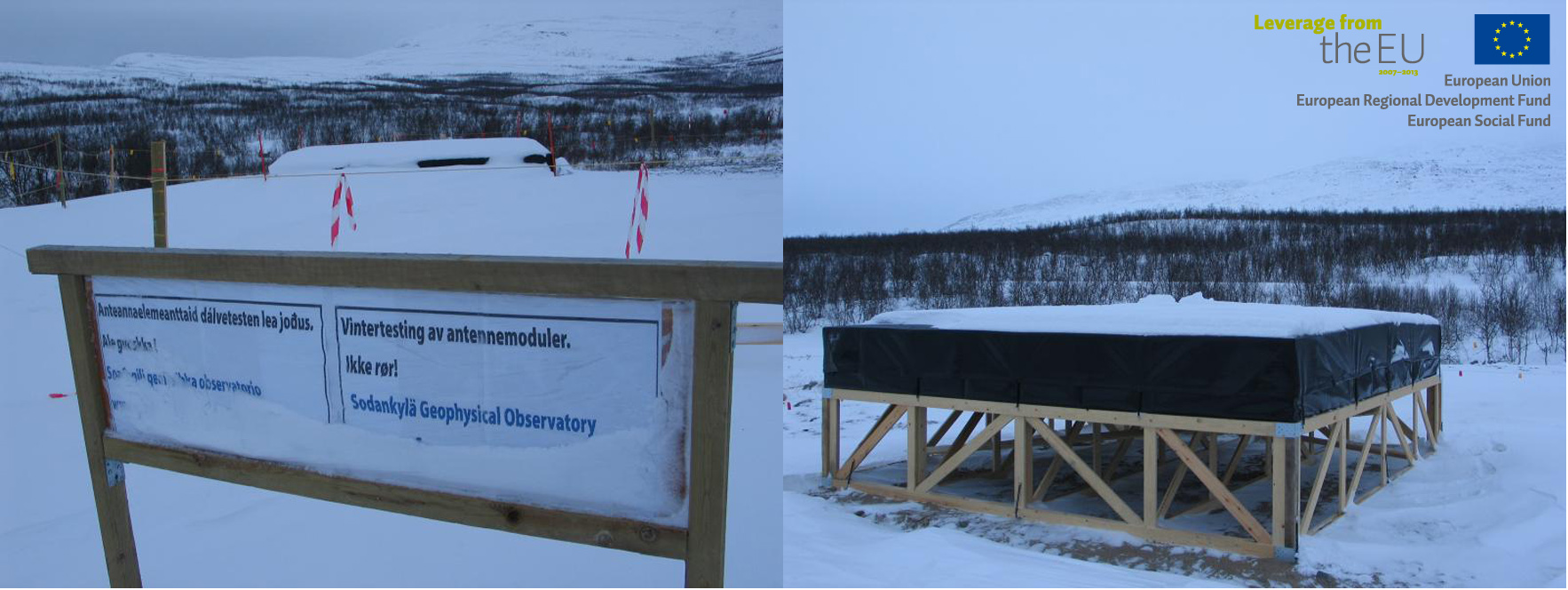
Featured today on the ASTRON image of the day are HBA tiles undergoing winter testing in Finland (Image reproduced below).


At LOFAR-UK we're delighted to welcome our Finnish friends to the International LOFAR Telescope. You can see details of the Project KAIRA (the Finnish LOFAR work) on their website and blog (both in English). As Chilbolton moves into an operational phase, and the big task of installation and commissioning has lessened, our LOFAR-UK Chilbolton Site Manager is now spending some of his time in Finland working on project KAIRA, so I think we can expect lots of updates on the progress on their blog.

Tuesday, January 25, 2011

LOFAR-UK on Facebook

I just made a page for the LOFAR-UK Chilbolton Station on Facebook. You can now find us here.

Friday, January 21, 2011

Intech Astronomy Day

LOFAR-UK was represented at this year's Astronomy Day at Intech. Sadie Jones (a Southampton PhD student) took along a temporary exhibit demonstrating the science and technology of LOFAR. She describes what she did on "Sadie's Outreach Blog"- Intech Astronomy Day.

Wednesday, January 12, 2011

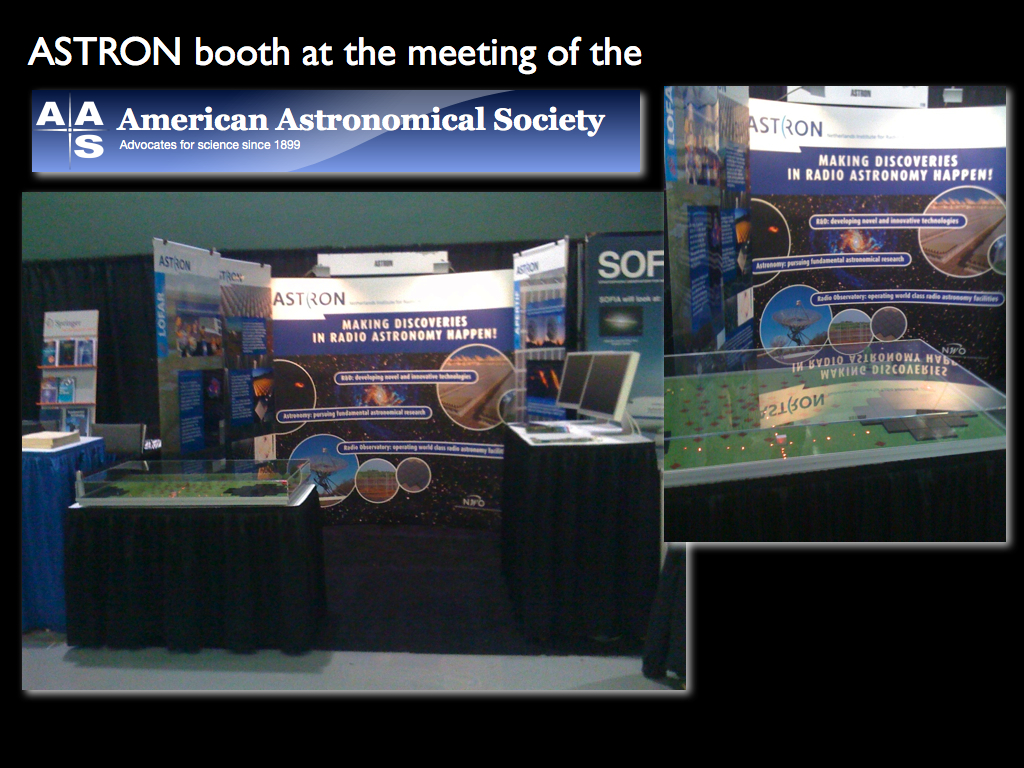
LOFAR at the AAS

LOFAR seems to be well represented at the American Astronomical Society meeting which is happening in Seattle this week. The booth has been popular thanks to a wonderful model of LOFAR station in a typical Dutch landscape.


(Picture from ASTRON image of the day for Jan 11th)


And yesterday they made some live observations using several of the Dutch stations (and one in Germany) which you can watch in the below video.


What a wonderful demonstration of how LOFAR works.  It's been getting some really positive attention on Twitter (search for 'LOFAR #AAS217' to see for yourself.). Well done to all involved. :)

Wednesday, January 5, 2011

LOFAR Related PhDs at Southampton University

There are two PhD positions are available to work on LOFAR related science at the University of Southampton. Below is the advert from Southampton. 


Cosmological Radio Transients: Novel Techniques and Optical Counterparts


- Prof Rob Fender (http://www.astro.soton.ac.uk/~rpf)

Two PhD positions are available to work in the newly-formed '4 PI SKY' team at Southampton, led by Professor Fender and funded by a 3 million Euro EC grant. The goal of the team is to coordinate and advance global efforts for the discovery, identification and understanding of cosmological radio bursts. These bursts are associated with diverse extreme astrophysical phenomena such as merging neutron stars, accreting black holes and supernovae. With these programs we hope to perform a real-time census of particle acceleration in the local universe, understand the growth of black holes on cosmological timescales, probe the nature of the distant intergalactic medium for the first time, and - just maybe - detect electromagnetic counterparts to the first-detected gravitational wave sources.

Professor Fender is joint project leader of radio transients programs on both LOFAR (www.lofar.org) and MeerKAT (www.ska.ac.za), two revolutionary new radio telescopes. The PhD projects available are (i) to work, in partnership with the Oxford University Transient Universe Studies group (OTUS), to develop novel techniques for the detection of transient events in the vast streams of data that will be produced by telescopes such as LOFAR and MeerKAT, and (ii) to work on the follow-up and classification programs for the optical counterparts of detected radio transients - only with these data will we be able to understand the physics behind the bursts that we detect.

Both of these projects will involve close collaboration with, and visits to, other collaborating groups in places such as Amsterdam, Cape Town and Sydney. The projects are funded for 4 years each and are open to applicants from across the EC. 


For more details on the group, and how to apply for the studentships,
please go to:

http://www.astro.soton.ac.uk/postgrad.html

Rob Fender and LOFAR in the Sunday Telegraph

An article on the LOFAR-UK lead scientist Prof. Rob Fender (Southampton Uni) and what he plans to do with LOFAR appeared in the Sunday Telegraph this weekend:
New telescopes peer back to birth of first stars